


Cold outreach for science sales teams remains incredibly valuable. It’s the process (or, in our opinion, the art form) of contacting prospects who have no prior or recent interaction with your company, with the end goal being opens, replies, meetings, and ultimately sales.
But let’s not sugarcoat it – it’s hard work. Cold outreach isn’t just a ‘spray and pray’ activity; instead, it requires proper preparation, good timing, and highly personalized messaging.
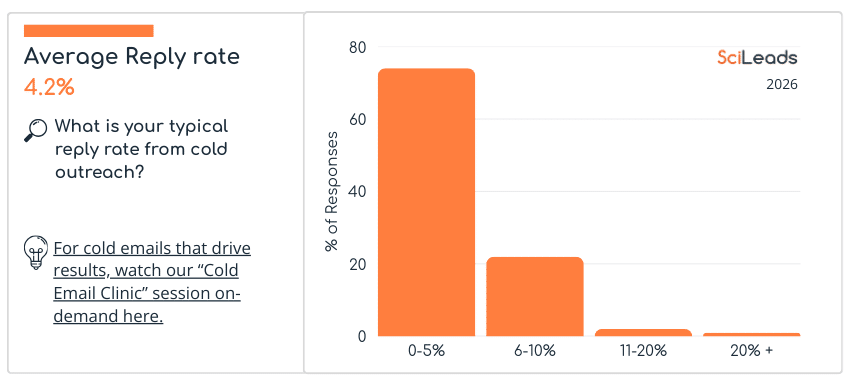
According to the Science Sales and Marketing Benchmark survey 2026, the average open rate for cold emails to scientists was 10.7%, whilst the average reply rate was 4.2% (although we have SciLeads users that are achieving 3x this👀). In the life sciences industry, success depends on reaching the right person, with the right message, at the right moment.
Whilst carefully curated emails are important, so too is the groundwork you do before sending anything out. This guide brings together best practices for life science sales teams, covering how to identify the best prospects, when to reach out to achieve better results, and how to craft messages that actually get responses.
Jump to:
Who to Contact- Segmentation
Cold outreach works best when the targeting is as carefully considered as the emails you’re sending.
Before sending a single email or making a call, it’s crucial to make sure you’re targeting the right people, with clearly defined segmentation.
One of the most common mistakes in email campaigns is sending the same message to every contact in your database. It may feel efficient, but it can damage engagement and future relationships.
Instead, think about the following:
- Research focus or therapeutic area
- Organization type (academic lab, biotech, pharma)
- Role or seniority of the researcher
- Recent publications
- Current research projects
- Recent funding
Aligning these segments with your messaging makes sure you are relevant, timely, and more likely to have your emails opened and replied to.
When to send cold outreach emails
Use the prospect’s signals to reach out at the right time for them
Scientists are trained to critically assess everything – so your cold emails are more likely to get opened if they directly speak to real activity happening in their world. Whether it’s funding announcements or new research, the more you know about what’s happening with your prospects, the better your chances of getting your emails opened.
This strategy is known as responsive selling (or contextual cold calling). For example, if you know a research lab has just secured a grant or an emerging biotech has received new investment, you can time your outreach to align with their budget availability.
Key prospect signals to watch for
Some of the key signs to look for:
- New research publications – indicating active projects and potential demand for tools or services.
- Grant awards or funding announcements – suggesting new budgets and purchasing power.
- Team or leadership changes – signaling strategic shifts or expansion.
- Conference participation – creating opportunities for outreach before or after the event.
These signals help you approach prospects when they are most likely to need what you offer.
SciLeads formula for cold emails
Tried and tested by our SciLeaders
Even with strong targeting, outreach will fall flat if the message isn’t relevant. Scientists receive large volumes of generic emails, so successful cold outreach depends on short, highly personalized messages that clearly communicate value.
Follow these steps to boost your open and reply rates:
- Personalize your outreach – It sounds so simple, but referencing relevant data, such as the prospect’s recent publications, grants, conference presentations, or company funding announcements, is proven to get a higher open rate.
- Keep emails simple – *slowly steps away from Canva* Plain text emails with a natural tone often perform better than highly stylized marketing emails.
- Write strong subject lines – Personalize your subject lines to reference the recipient’s work – they are much more likely to open it if they see their own name!
- Directly connect their work to your product – make it super obvious why YOU are emailing THEM. If they gave a poster on PCR, and you offer PCR reagents… say that! You have seconds to show why your world and their world can, and should, overlap.
- Use one clear CTA – Make it easy to respond by asking a single question or suggesting a meeting time (e.g., “Would Tuesday at 2 pm your time work for a quick call?”)
- Humanize the message – In a world of AI messaging, stand out by sounding like a real human. Avoid super corporate language, and use a friendly, helpful tone. You don’t need to be perfectly polished either; small imperfections (even the occasional typo) can make your message feel more real and relatable.
Finally, remember that responses rarely come from the first email alone. Be politely persistent with follow-ups, adding new value or context each time rather than simply repeating the same message. (Click here to jump to the section on follow-ups)
💡Tip – We’ve made a cheat sheet with more tips on how to write cold outreach emails that actually get opened.
Create multiple touchpoints for cold outreach
Cold outreach isn’t limited to a single channel.
In fact, combining several channels often produces the best results for cold outreach. Ever thought of using video? Picking up the phone? Using a spread of touchpoints keeps you front of mind for your prospects, and the highest performers are using multiple channels.
There’s no doubt, email remains one of the most effective outreach tools. Billions of emails are sent every day, and many professionals check their inbox first thing in the morning. However, because inboxes are crowded, your messages must stand out quickly.
Email offers several advantages:
- Direct access to the prospect’s inbox
- The ability to personalize messages
- Easy follow-ups and tracking
💡Tip: Email allows for personalized outreach at scale. If you want to learn how to use mail merge to pull in personalization fields like prospect’s paper titles to your messages, take a look at our blog.
Telephone
Cold calling is still one of the most effective ways to reach a scientific buyer. If you are a SciLeads customer, you can leverage a wealth of scientific activities, industry insights, and organizational updates to find contextually relevant reasons to contact your prospects (Remember the previous section on contextual cold calling?).
Contextual cold calling aligns your outreach with real activities and milestones in your prospects’ professional lives. When timing is everything, being the first to congratulate someone with a quick phone call can go a long way.
The Science Sales and Marketing survey 2026 showed that 71% don’t use phone calls in their mix, but high performers are more likely to use them.
A phone call is a simple way to be human, be personal, and make a lasting impression. How many emails have you received today? How many phone calls? Giving prospects a chance to hear your voice, have a chat, and make the connection that you’re a real person, not just a faceless email, can make a great impression that keeps you in mind.
💡Tip – our Science Sales and Marketing survey found that high performers are using more channels, and despite the phone being underutilized, those who do phone calls are experiencing 20%+ reply rates.
How to follow up with confidence
Research suggests it can take 7–11 touchpoints before a prospect engages.
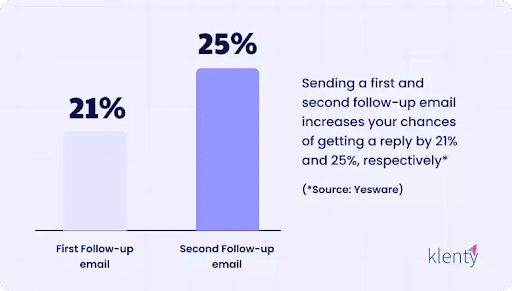
Source: Klenty
We recommend following up strategically over 10-14 days with 2-3 touchpoints. Here’s a simple guide to follow:
- Day 1: Initial outreach introducing your company and value proposition.
- Day 4-5: Follow-up email with additional value, such as a relevant case study or industry insight. See below for more examples! (Note: Keep an eye on SciLeads socials for regular industry insights and updates that you can use)
- Day 10-14: Final check-in email offering a last chance to engage before you move on.
Avoid emailing multiple contacts from the same company on the same day, as their system may flag this as spam. Instead, space out messages strategically:
Send useful content
Every follow-up email must provide new value or information, rather than simply asking if the previous email was received. Informative content builds trust and credibility, making them more likely to engage with your outreach.
- Share a blog post or case study relevant to their research.
- Offer a downloadable PDF with industry insights.
- Use link tracking to see who engages with your content.
- Consider sending short video messages for a more personalized touch.
Utilize other channels for follow-up
As we mentioned earlier, multiple channels are your friend. If a prospect doesn’t reply to your email, try connecting on LinkedIn. LinkedIn messages often have higher conversion rates than emails, and prospects are more likely to respond when they recognize your name from multiple touchpoints.
- Send a connection request with a short, non-salesy message.
- Engage with their posts and articles before reaching out.
- Message them with a brief follow-up, giving them something of value – a free calculator, whitepaper, or benchmarking study.
- Participate in relevant LinkedIn discussions to stay visible in feeds.
- Post about topics that interest your ICP – share a recent paper and why it interested you, to show you’re genuinely interested in their world.
💡Tip: SciLeads provides LinkedIn profile links for most contacts, making it easy to connect.
Don’t let email threads drag on
If you keep following up in the same email thread, it becomes obvious: “I’ve already ignored this a few times…”, which makes a reply even less likely.
Keep the thread short; just replying to your first message is usually best.
Keep your data clean and up to date
The hidden cost of data decay
Data degradation, data decay, dirty data… they all mean the same thing: your data is no longer working for you. Even the Rolls-Royce of cold emails will fall flat if the contact information behind it is outdated or inaccurate.
In life sciences, this can happen quickly as researchers move institutions, labs shift focus, and funding priorities evolve. Some reports suggest that up to 70% of data becomes outdated within a year, making data decay a constant challenge for teams relying on accurate researcher information.
Poor data quality can affect sales and marketing efforts by:
- Missed connections: If key contacts have moved roles or left an organization, your outreach may never reach the right decision-maker.
- Lost momentum: Working with poor data slows processes and delays relationship-building.
- Lost trust: Reaching out about papers or research that are old and no longer relevant makes it look like you haven’t done your homework. This can hurt your relationship with customers if they feel misunderstood.
- Incomplete buying groups: Research projects typically involve multiple collaborators and stakeholders. Relying on outdated or incomplete data can mean missing important influencers in the decision-making process.
Outdated data quietly undermines outreach efforts, leading to wasted sales time, higher email bounce rates, lower campaign performance, and ultimately lost revenue. Keeping your data clean ensures your (perfectly crafted) outreach reaches the right people and gives your sales team the best chance of starting meaningful conversations.
Summary
Scientists are trained to assess everything critically, so your sales outreach must show clear relevance.
- Segment your audience; sending a broad message about a product that only applies to 10% of your list risks losing the trust of the other 90%.
- Time the outreach; read the signals from the prospect’s world – did they just publish a paper? Secure funding? Confirm a talk at a conference? These give you reason to reach out and reconnect.
- Craft the message; personalize everything – from your subject line to the introduction. Then give a clear CTA, and end on a question.
- Polite persistence across channels – follow-up by email, phone, LinkedIn DMs, and even video note. Add value each time – share a new paper, a free tool, your news, or congratulate them on their news.
- Work from current data – don’t keep referencing their 6-year old paper from a project they’re no longer on, it’s a fast way to show you didn’t do your homework and don’t really understand their world.
SciLeads lets you search and filter to find scientists currently active in your niche, then personalize messages at scale by bringing in their paper or talk titles to your message via mail merge. This approach is already improving open and reply rates for thousands of users selling to scientists. Request a free trial here to see for yourself.