
Ask a Customer Anything: Academic Scientists
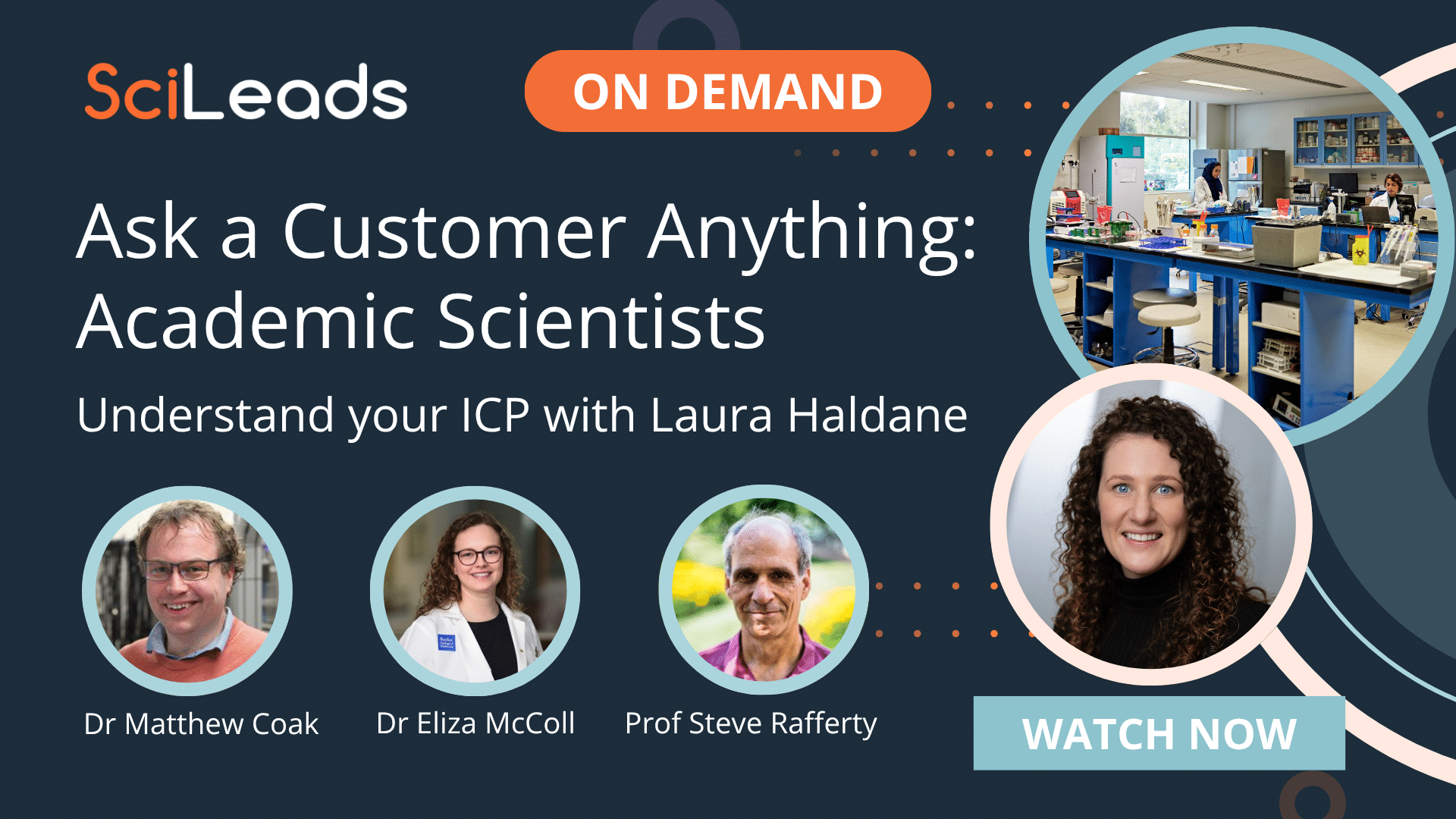
We interviewed a panel of 3 academic scientists to understand exactly how they buy equipment and consumables for their university labs – this is what they said.
In summary; academic scientists making a purchase start their research on Google (choosing supplier websites over the AI overview), by conversations at conferences, the methods section in a paper they want to emulate, or via recommendations from their network. They want to get specific details from a human when they need it, and have conversations with suppliers by email or in-person. They highly value hands-on trials, demos, or site visits to cement their understanding – and this face-to-face relationship building with the supplier also eases the risks in their minds. Free samples are the best, sometimes only, way they would change consumables brand. They don’t want to be annoyed by repetitive “just checking in” notes. And they confirmed – even after their funding is awarded, they can still change their mind on the specific brand to buy!
Read on for the full breakdown of their preferences along the buying journey.
Jump to:
- Watch on-demand
- Audience feedback
- Sources: Who we Interviewed, and their Scientific Fields
- How Academic Scientists Find Products for their Labs
- Conferences and Tradeshows
- Scientist-Supplier Meetings and Relationships
- Communication During a Sales Opportunity with Academic Scientists
- How to Convert Academic Scientists to a New Supplier
- Who to Engage when Selling to an Academic Lab
- Purchasing Cycles and Funding Cycles
- The Impact of NIH Funding and Tariffs on Academic Scientist Spending
- Using Networks and Social Media to Connect with Scientists
- Advertising to Academic Scientists
Watch On-Demand:
Audience Feedback:
“This is extremely a value-add for me! This is briliant. Do you have more of these? I’m going to share this with my sales team, marketing team, and product managers.”
Product & Growth Marketing Lead, Biomaterials supplier.
“Incredibly helpful. It was good to hear they still like emails if they are serious about buying something. Looking forward to the next one!”
Senior Sales Operations Manager, Imaging Systems supplier
“Thanks for the very insightful talk yesterday – especially that FOC samples are highly appreciated, and a step in the door!”
Sales Manager, Reagents supplier
Sources: Who we Interviewed, and their Scientific Fields
This writeup draws on a panel discussion with 3 academic researchers across physics, biochemistry, and biology, in the UK, USA, and Canada.
- Dr Matthew Coak – Assistant Professor and UKRI Future Leaders Fellow, University of Birmingham – UK. Matthew works in experimental physics, synthesizing 2D materials and measuring them at extremes of low temperature, high pressure, and magnetic fields. His lab uses a lot of cryogenic equipment, and precision polished diamonds.
- Dr Eliza McColl – Postdoctoral Research Assistant, Baylor College of Medicine, Texas USA. Eliza’s work examines the impact of viruses on fetal and placental development – so her commonly used techniques are tissue culture, 2D and 3D cell culture, microscopy, immunohistochemistry, and western blots.
- Professor Steven Rafferty – Prof in the School of Chemistry, Trent University, Ontario Canada. Steven’s research on protein expression, purification, and characterization uses a lot of consumables like culture media, flasks, pipettes, and on the equipment side chromatography, UV-visible spectroscopy, free radical analysis, microplate readers, and NMR.
How Academic Scientists Find Products for their Labs
We first asked the panel; what is the first step you take when you know you need to buy something for the lab?
For equipment purchases, Eliza and Matthew agreed that Google is their first port of call. The large players like Thermo Fisher, VWR, or Sigma were standard for all 3 of our guests to get an initial sense of options and prices.
Steven added that for some specialist instrument types, he knows there is only one manufacturer – so goes straight there. He would also ask about second hand instruments, or ask other labs in his university to see what they have and if they like it.
Using AI for finding lab equipment got mixed reviews – with one of our scientists saying they skip straight past the AI overview on Google, but another saying they find LLMs useful to suggest alternative brands they might not have heard of.
Eliza has a lab manager, so her first step for standard products is asking them to assist in the search – as they are familiar with the suppliers, discounts, and terms etc.
For smaller items and consumables, often the scientists are constrained to use only approved suppliers already on their university’s list – but this can be overcome (see section on How to convert academic scientists to a new brand).
Conferences and Tradeshows
All of our panel agreed that meeting lab vendors at conferences and tradeshows is incredibly helpful. They value the chance to see products first-hand, and talk face to face with a knowledgeable expert.
“I would be assessing them on their technical abilities. If you put someone on the booth that didn’t know anything about the product – I would be quite put off. But if there’s someone there who can confidently talk to me about the design, and how it works, and give me hard specs, and say here’s my card, then you know – that goes on the wish list and maybe I’ll buy one later.” – Matthew
In terms of visiting booths, good swag was seen as a great motivator to swing by! Beyond that they would pass by every booth, and stop to talk to those that look relevant. In fact during conference breaks, there is often nothing else to do – so visiting booths to see new developments first-hand was seen as both a useful and interesting way to spend that time.
Posters or talks by suppliers were agreed as something they would interact with;
“I’ve been at symposiums where suppliers present new technology as a poster, and it’s usually one that I’ll stop by just because it feels like less of a sales interaction and more of a scientific interaction – which I think some scientists are more comfortable with.” – Eliza
Conferences are not the only way to give scientists first-hand experience of your products. Lab tours (visiting peer labs, or manufacturer’s sites), and campus visits were also highly valued as a chance to see equipment in action and ask in-depth questions. More on that below.
Scientist-Supplier Meetings and Relationships
Beyond conferences, meeting suppliers in person was cited as really important to all our scientists.
“So the best sales reps we have around Trent, the ones we remember, are the ones who were always around and they made their faces known,” – Steven.
The guests all mentioned that the trust built through in-person visits and discussions was vital. It gives them confidence there is somebody to ask about teething issues, questions, or if they need custom modifications.
“This is the line on the grant – once we’ve used it we can’t go back and buy a second one, right? We only get one chance at it, so we want to be confident.” – Matthew
These meetings do have to be on the right terms – dropping in unannounced was a big dislike. Scheduled one-on-one meetings, or campus visits to host trial equipment, or a lunch and learn, were seen as really valuable. Steven mentioned that a rep saying specifically “I’ll be on campus on this day” makes it more likely for him to respond. Eliza noted that her campus has very high security, so visits must be pre-agreed.
The panel universally disliked chat bots, mentioning that they are OK for “garden variety” items like standard consumables, but they would never purchase larger equipment or instrumentation without speaking to a human.
Communication During a Sales Opportunity with Academic Scientists
As for how to contact academic scientists – all of our guests agreed that email is king. Two of our three guests said their office phones don’t even work.
The panel agreed they’re more likely to interact with sales or cold prospecting emails that are personalized – referencing their publications or pre-prints. However, these have to be done correctly! “I saw your paper on electronic materials – would you like to buy cell culture media?” would be an immediate red flag and delete. SciLeads lets suppliers find scientists working in a specific niche, or with a specific technique, for outreach that makes sense and gets replied to.
Marketing emails and newsletters were seen as moderately useful – with Eliza saying she will skim read them for special offers, and Matthew adding that learning about new launches from instrument manufacturers is useful.
Nurture sequences were disliked “If I haven’t replied, there’s probably a reason for that” said Matthew, and Eliza agreed “If someone’s contacting me on a monthly or weekly basis with updates, I’m not going to read them.”.
However the panel did agree that learning about new developments is useful – so making sure each email has new, relevant, useful information (not “just checking in” !!!) is crucial to maintain your relationship and reputation. More on the best practices for cold emailing scientists in our writeup and recording here.
LinkedIn was the only social media platform mentioned as being used – more on that in the section Using Networks and Social Media to Connect with Scientists.
How to Convert Academic Scientists to a New Supplier
The scientists all expressed that changing product or brand is a hurdle – but not impossible to do.
Changing lab products comes with risk; it could alter experimental outcomes (wasting time and budget). It may also be that they are trying to replicate a method from a paper, so they want to use the exact same catalog numbers. They are also sometimes limited to using approved suppliers on their university’s system.
Samples and price were cited as the main ways to overcome these hurdles. The panel agreed that they would try free samples they were given – and in fact this might be the only way they would try a new product.
“We know that a process works if we do exactly these things, exactly this glue, exactly this… and we’re so scared to change it! The way to get us over that is, I think, free samples. Then I’m not taking a risk” – Matthew
Replicating a method from the literature was another instance where they might insist on a specific supplier, even if they are new. This means that having your reference papers to hand, and sending those out to new prospects is definitely a powerful way to get their attention.
“That’s probably the first place that I’m going – somebody who’s published on it. Looking at exactly which catalog numbers and equipment they’re using – just to lower the risk of replicating [the technique] and it not happening because the media is different or something like that. Before Googling, if I have a specific assay or new experiment I want to try, I’m definitely going to the publications.” – Eliza
For equipment, visiting either peer labs to see an installed and working piece, or the manufacturer’s site, were ways to get this “trial” experience that could turn the scientist’s head to a new brand or supplier.
Eliza mentioned a time when her lab got the instrument for free, on condition of buying a certain number of the consumable kits in the first year. This was the only way they would have been able to get it – and actually they continued buying the consumables beyond the first year as it was so routine by then.
Who to Engage when Selling to an Academic Lab
Despite the common feeling among lab suppliers that PIs are too busy, and we need to speak to post-doc students – the panel agreed that engaging professors is important. Even if your interactions are with the post-docs, this might be because their supervisor has asked them to research a specific purchase on their behalf. Multi-threading and getting buy-in from both the direct users (post-docs) and the economic buyer (professor) is going to be needed to close the sale of lab instrumentation.
Purchasing Cycles and Funding Cycles
An important question for those selling to scientists – is it too late to engage with a scientist, if they have already received their funding? No!
Our panel agreed that actually they are MORE ready to discuss specifics and seriously think about buying, after their funding has come through – although they might need information at all stages.
“If I’m buying a big piece of kit, that has to be years in advance,” said Matthew. His timeline for buying cap-ex laboratory equipment is;
- Year 1 – decide experimental direction, write grant or funding application. Get quotes from 3 vendors to use as evidence and put accurate estimates into the application.
- Year 2 – hopefully the grant is approved, finalized, and the money comes through.
- Year 3 – now able to place the order, and will return to the quotes – or request new ones from other vendors.
Steven told us about a specific grant where he named one brand, but ended up buying another after the grant was approved. He explained that as long as he hasn’t committed yet, he’s open to comparing options. This is particularly true for equipment they expect to keep for a long time – they want to consider options carefully and make the right choice.
The Impact of NIH Funding and Tariffs on Academic Scientist Spending
The elephant in the room for recent years – Eliza, our representative for the US, confirmed that NIH changes have had a huge impact on the way their lab spends and thinks. In fact her supervisor and their whole lab is moving institutions because of NIH funding changes.
“The institution itself has placed a lot of constraints on what we can and can’t purchase. Someone from our lab tried to purchase mechanical pencils, and was told no we have some in the office, you can’t place this order – so the purchasing power has definitely shifted. Hopefully that will change at a new institution that hasn’t been impacted as much” she explained.
Tariffs were mentioned as making products and spare parts from America more costly to those outside the US.
Using Networks and Social Media to Connect with Scientists
Social media was not widely used by this group, with two of our guests saying they’re not on any social media platforms.
“Twitter, at least in the US, was the most largely used social media for scientists. It seemed bigger than LinkedIn I would say. But then when X happened, there was definitely a migration. I know people tried to get on BlueSky but it never really took off, so I have seen more of a shift to LinkedIn – but to be honest I rarely check my LinkedIn unless I’m going to a conference.” Eliza explained.
As lab equipment providers, this means that a presence on LinkedIn is still valuable – for those occasional logins around key conferences, you want to be ready and visible on their feed. Watch our session on using LinkedIn to connect with scientists here.
Those not on social media rely on their personal networks – contacts from past collaborations, conferences, or organizations, is where they would turn to for advice. So your service and support to every customer, big or small, is going to be reflected in those private recommendations!
“For larger pieces of equipment, you really want to go by the companies that have the reputation, not just for good instruments but for good support too.” – Steven
This presents a huge opportunity for referrals via trusted mutual connections. SciLeads users can use the network feature to find new leads from existing customers – details here for SciLeads users, or get a free trial here to try it yourself.
Advertising to Academic Scientists
Two of our scientist guests didn’t read industry magazines or websites, so said they would not see ads or coverage there. One stated he does, and so ads in the field-specific magazines would subconsciously sink in.
However this is slightly counter to later comments that they would not always choose the cheapest option. If there is a choice to go with a brand or company they know, that is seen as the safer choice;
“If it’s a company I’m familiar with, I’m probably more likely to go with them just for potential reliability sake, so I think notoriety and just the name carries a lot of weight” – Eliza.
That feeling of “safety” and seeing a brand as established can come from the multiple touchpoints that ads, PR, and social media create – seeing that the company is big enough to invest in having a presence.
To ensure your ads are seen by the right audience, make sure that your targetting is precise – for LinkedIn ads, SciLeads can be used to import an exact audience based on their publications and funding, rather than potentially outdated LinkedIn profiles.
Learn More
“SciLeads has been critical to the success of our sales and marketing efforts. I don't know where we would be without its data and insights.”
