
Cold Email Clinic: Fix Your Text Live

How to Write Cold Emails to Scientists
If you’re selling to scientists, predictable sales-y emails won’t cut it. Tired jargon, weak questions, unclear offerings, and lazy “spray and pray” tactics just get you ignored.
Your product is great, your service is great – so make your first impression, your outbound prospecting, great too!
In this workshop, we show you how to rewrite your cold emails and prospecting messages to get more opens, more responses, and more sales.
Our audience even put in their emails and prospecting messages anonymously in the Q&A box, for Laura to review.
Speaker Laura Haldane is the CRO at SciLeads. She has been selling to scientists and supporting scientific sales and marketing for over 16 years, applying her psychology background to connect with buyers and drive results.
What You’ll Learn About Emailing Scientists:
- Subject Lines: your first impression and chance to stand out.
- Personalization: relevance = replies.
- Humanization: how to show you’re not a bot, and truly connect.
- Calls to action: keeping it clear and closed.
- Mistakes: the red flags that are tanking your reply rate.
- Follow-ups: how to reconnect without being annoying.
- Psychology: simple edits that stop a scroll and speak to the human.
Audience Feedback:
- “Fantastic webinar! I learned a lot.” – Digital Marketing Co-Ordinator
- “I just used one of the tips and got a meeting booked for Monday!” – Customer Account Manager
- “Thank you for the session – some of your tips I am already using, others I will adopt!” – Business Development Lead
- “Really useful! I see where I might be going wrong with my emails.” – Sales Specialist
- “Great energy, insightful content, and you had me chuckling away at your banned words slide.” – Marketing Consultant
Notes on some of the key points covered:
- Why generic emails don’t work
- How to personalize emails to scientists
- Connecting your product to their work
- One CTA is enough
- Recap: Key rules of a cold email
- How to structure follow-up emails
Why generic emails don’t work
In this webinar, Laura highlights how generic outreach to everyone wastes money and opportunities. After attending ELRIG Drug Discovery, she received numerous scientific sales emails despite not being a scientist, showing that senders had spent no time targeting their prospects. By taking the time to tailor emails to specific people, you get a much higher response rate, and ultimately a better ROI from tradeshow campaigns.
Rather than mass emailing an entire database, spend some time segmenting the list to pick out relevant prospects. There is also a right time to send your email, such as before a tradeshow like ELRIG to book meetings at the event, or when a researcher has received funding. We talk more about segmentation and timing in our Ultimate Guide to Cold Outreach for Science Sales.
How to personalize emails to scientists
It all hinges on the subject line. There is no point putting every effort into the email body if the person doesn’t even open it. Make sure you use something specific to the recipient, such as their publication, conference poster, or grant, to signal that the email concerns their work specifically. Use their name so it catches their eye as they quickly scan their inbox. Anything that says, “I have read your research, and I am specifically sending this to you.”
It is best to avoid image-heavy emails, not only can these get caught in spam filters, but they immediately signal mass marketing, encouraging recipients to move on. By using plain text for personalized, one-to-one outreach, it feels like a message intended for an individual. It may seem boring, but a simple email makes the communication feel more personal and is more likely to receive a response.
It also helps to change your spelling depending on their location, so if they are in North America, for example, use ‘ize’ rather than ‘ise ‘, e.g., ‘personalize’ not ‘personalise’. You should also change your settings so you are displaying your name clearly and using a sender photo to help humanize the message, rather than just your email address.
The industry that we work in, we have such an array of publicly available data. We have Google Scholar, we have NIH RePORTER for the grants, we have LinkedIn. There’s so much out there in terms of their research, we really have no excuse not to personalize our outreach.
Connecting your product to their work
Make the connection between the scientist’s research and your product explicit. We all want to make our killer pitch, but if you want to get their attention, then you need to start with the scientist’s work rather than a generic introduction to your product. Try referencing a poster they presented or a specific research interest to highlight why you have chosen to contact them. Explain why your offering matters to that individual, rather than simply claiming that your product is the best.
Laura warns against sending recipients to a website and expecting them to work out the relevance themselves. Explain the specific benefit in the email and direct them to the information that supports it, making the message easy to understand and act on. Make your message about how you can help them, not the other way around.
One CTA is enough
Scientists have enough research to do, so rather than give them another task, make replying to your email quick and easy. Instead of saying “Let me know if you want to chat” or asking recipients to book through a meeting link, provide one specific call to action (CTA) that requires very little effort to answer.
Simply say, “Does Tuesday afternoon or Wednesday morning suit you“? That way, you aren’t putting the onus on them to decide what suits, but you are also giving the impression that you’re busy with only two slots remaining and they should snap one up.
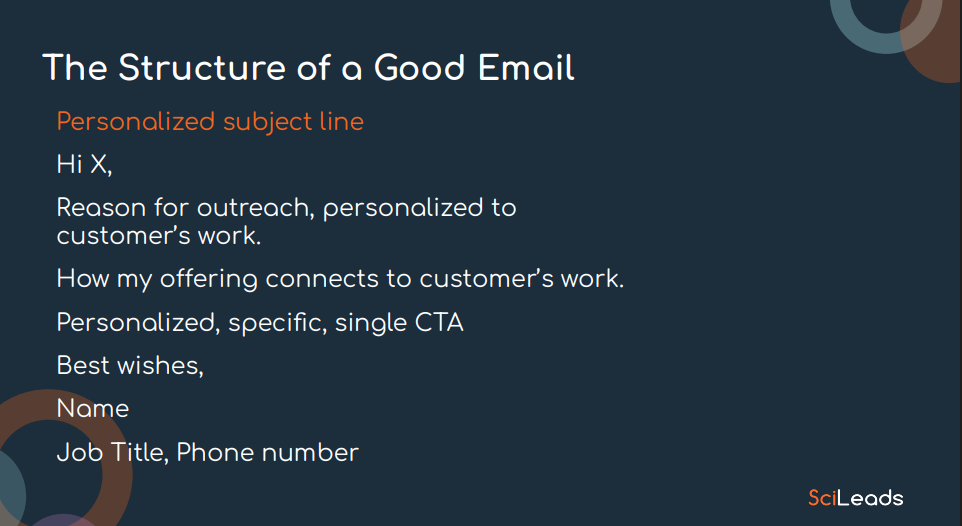
Recap: Key rules of a cold email
- Only contact relevant people and personalize everything
- Cut out unnecessary words and brochure-style pictures
- Explain why your offering matters to them specifically
- Make responding easy with one clear call to action
How to structure follow-up emails
Your outreach worked and you got a response, or even met someone at a show, but you’ve emailed them again and had no reply, what do you do? Following up is an essential part of the process, but again, you need to give the recipient a good reason to reply.
Avoid weak reminders such as “just following up”, asking whether an email was received, or sending a one-word “Thoughts?”. Instead, write a short, specific question above the original message, with one call to action and one recipient. Don’t just resend the same message over and over – you need to keep adding relevant information.
There might be a good reason why they haven’t replied yet, such as annual leave, or they are still travelling back from the show so think about the best time to contact them again. If you still get no response, consider contacting an appropriate colleague or even switching to phone or LinkedIn when emailing stalls.
Here are some ‘Do’s and Don’ts’ for follow-up emails to scientists:
| Don’t | Do |
| Last chance to register! | If you haven’t already registered |
| Are you still interested? | Is now a better time? |
| No problem, let’s connect in Jan | Perfect, what day suits you, and we’ll get that scheduled |
| Let me know if I can help | How can I help? |
| Let me know if you had any issues | Do you have any questions? |
| I’m free all afternoon | I’ve two remaining slots |
| Hopefully you had a chance to | What did you think of the proposal? |
| Write like you wouldn’t speak normally | Speak like a normal human |
| Be perfect all the time | Make the odd mistake! |
| Repeat the same words or points | Be succinct |
Speaker

Laura Haldane
SciLeads
Laura is the CRO at SciLeads. She has been selling to scientists and supporting scientific sales and marketing for over 16 years, applying her psychology background to connect with buyers and drive excellent results.
“SciLeads has been critical to the success of our sales and marketing efforts. I don't know where we would be without its data and insights.”
